


Today, the world’s most important chess tournament of the year comes to a close. In sunny Cyprus, despite a war raging less than 200 miles away, eight of the world’s top human players have gone mano a mano in a double round-robin tournament with their whole careers on the line. The prize is not just mere cash (€70,000 for first place) but the chance to challenge Gukesh Dommaraju next year for the ultimate title in chess: world champion.
The chess community was rife with drama and speculation going into what is known as the Candidates Tournament. Was the American Twitch streamer Hikaru Nakamura’s qualification legitimate? Would the perennial contenders Fabiano Caruana or Anish Giri break through? Or perhaps, per the Reddit memes, the heavy underdog Matthias Blübaum might shock the world by making chess history with a perfect sweep?
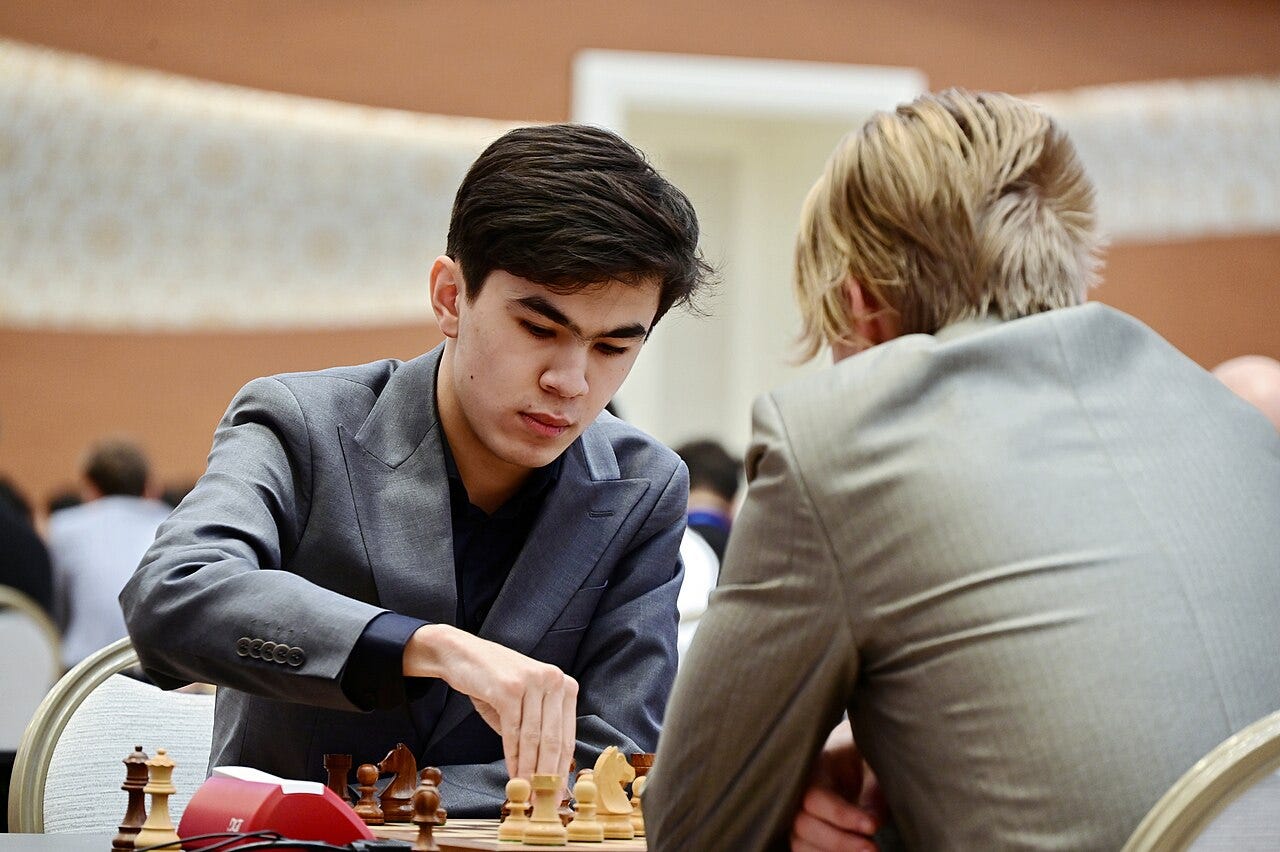
The result: Javokhir Sindarov, the twenty-year-old unibrow prodigy from Uzbekistan, took the tournament by storm. In his very first game, Sindarov found himself in a poor position against Esipenko. But Esipenko miscalculated and blundered, and Sindarov capitalized and won. He never looked back — with six wins, eight draws, and zero losses, he dominated with the highest ever overall score in this era of the Candidates.
Of course, if there had been an AI player in the tournament, it would have won every single game.
And yet, the existence of ultra-dominant AI has not destroyed the game or people’s interest in it, both to play socially and as fans. In fact, chess has never been more popular in its 1,500 year old history.
But AI has radically altered the nature of the game. Every top player uses AI engines extensively in their studies — and instead of sapping the game of its creativity, watching the way Leela or Stockfish (top chess engines) play has made human players more creative and more aggressive.
It has also introduced a culture of suspicion. Accusations of cheating have flooded the game, leading (most likely) to the death by suicide of one of the sport’s foremost players and commentators last year.
Understanding how AI has shaped the chess world may reveal a lot about what the rest of us — writers, coders, artists, thinkers, and human beings — can come to expect from AI: as a tool, as a competitor, and as a major epistemological crisis.
Exactly thirty years ago, the world chess champion Garry Kasparov faced off against IBM’s Deep Blue. At that point, chess AI was in what I’d call the uncanny valley of ability. It was very, very good. But could it beat the world’s best player, arguably the greatest player anyone had ever seen?
In 1996, no. Well, kinda. It won two games, but ultimately lost 4-2. Humanity triumphed. But the next year, they faced off again. Deep Blue won. Kasparov was particularly shaken by an unexpectedly brilliant move in Game 2 that he thought was too “human-like” to be possible. It’s funny now to think about Kasparov accusing IBM of cheating…by using humans! (In reality, later analysis showed Kasparov was partially right — the move made no sense for a computer — but was chosen because of a bug, where the computer, evaluating too many options, chose a move at random.)
Thereafter, the AIs took off, and left us mere mortals in the dust. And what should have meant the end of humans playing chess…never came. Surprisingly, the fact that AIs could do better simply wasn’t that relevant. The competition anxiety faded because AIs were so much better that there was no point in comparing. Who wants to see a race between a flea and a fighter jet?
What fans hungered for was the humanity of the game — how it feels to beat your friend with a smothered mate, the pitter-patter of your heart as you watch your favorite player execute an elegant rook sacrifice or miss the one winning line (which you know because you’re following along with an AI engine).
But while chess players no longer saw AI as a competitor, it still had a major consequence for the culture: it made human performance unverifiable. Recently, there have been two high-profile cheating accusations, which serve as strange mirror cases of one another.
The first started in 2022, in St. Louis (America’s chess capital) at one of the most prestigious tournaments in the world. A nineteen-year-old American, Hans Niemann, shocked everyone by beating former world champion Magnus Carlsen, ending his 53-game unbeaten streak. The next day, Carlsen withdrew from the tournament and posted a cryptic meme tweet: “If I speak, I am in big trouble,” which everyone read as an accusation.
The chess world exploded. A meme proliferated on Twitch claiming Niemann cheated using anal beads to receive engine moves via vibrations. It spread — soon Elon Musk was promoting it. Suddenly people who had never thought about chess once in their life were making jokes about Niemann.
What followed was messy: Niemann admitted to cheating online as a teenager, Chess.com published a damning report, and a $100 million lawsuit was filed and quietly settled with no one admitting wrongdoing.
Last week, a new Netflix documentary dropped that added more layers. Carlsen admitted there’s been no evidence of Niemann cheating offline — but he also describes the logic that trapped him, and has trapped the whole chess community. Once Carlsen knew that Niemann had previously cheated online, for Carlsen, that was “the confirmation that I needed. This guy is cheating.”
Four years later, there’s no satisfying resolution, just an air of ambiguous impropriety that no one knows how to settle. The culture and the community could neither convict nor acquit any of the parties involved.
The second story, instead of being a tragicomedy, is just tragic.
Daniel Naroditsky was a beloved figure in the chess community. A strong grandmaster, at 29 he was a hugely popular YouTube and Twitch streamer, whose commentary introduced the game to a new generation. He was universally respected and admired by fans and peers alike.
That is, until October of 2024, when Vladimir Kramnik — a former world champion from the early 2000s — began a vicious campaign of “just asking questions” about Naroditsky’s astounding speedchess results. Chess.com had already banned Kramnik from prize tournaments for spreading baseless rumors about other players.
There was no evidence, and likely no truth to Kramnik’s insinuations. But soon the mobs of online hate came, and despite most other grandmasters dismissing the accusations, the situation deeply wounded Naroditsky. After all, Kramnik wasn’t just any player: he was one of his heroes, someone he’d looked up to as a child.
In his final Twitch stream, Naroditsky referred to his reputation: “That is all I have.” He was devastated that, in his words, one of the most influential people in chess believed he was “a completely morally bankrupt individual.”
Naroditsky was found dead at his home in North Carolina three days after the stream. The chess world was shook. I watched Nakamura break down crying as he spoke to his Twitch audience. Carlsen said he regretted not saying publicly sooner that he didn’t believe Naroditsky cheated. Kramnik expressed “sadness” for his death, but denied responsibility and claimed that he, himself, was the victim of a bullying campaign. No resolution, just devastation.
Chess entered the uncanny valley of ability thirty years ago. Writing, art, code, music, academic work — they all entered about three years ago. And the early symptoms are the same: accusations of using AI are wielded like weapons, detection tools don’t work reliably, and institutions don’t know how to adjudicate the mess.
Last month, a writer tweeted about a New York Times Modern Love column that seemed suspicious to her: “I don’t want to falsely accuse writers of AI-use,” she wrote. “But this reads EXACTLY like AI slop.” The original tweet, of course, embodies the problem. We don’t want to falsely accuse people, but sometimes we do. (In this case, the writer copped to using AI for editorial feedback — which in my opinion seems reasonable, but the writing did have the argot of LLMs.)
If that murkiness is akin to the Niemann case, then the mirror case is Ben Moran, the Vietnamese digital artist who spent over 100 hours creating a fantasy book cover in Photoshop, but was immediately banned from Reddit’s r/Art for violating their “no AI art” rule. When he appealed and offered to share the raw PSD file for proof, the moderator responded: “Even if you did ‘paint’ it yourself, it’s so obviously an AI prompted design that it doesn’t matter.” He was told to “find a different style.”
The big difference between AI in chess and AI in real life is that it’s obvious how AI ought to be used in chess, even if some people can’t resist the temptation to cheat. The goal in chess is to win the game (and, perhaps, to create beauty while doing so) without using outside help. But there’s absolutely nothing wrong with using an AI engine to study or prepare. In fact, it would be malpractice not to.
The same can’t be said for using AI in other aspects of life, where both the goals and the way the technology can help you are hotly debated. When the Washington Post columnist Megan McArdle tweeted about how she used AI to do research, transcription, thesis pushback, trimming, and fact checks, she became the “main character” of Twitter as other writers piled onto her for outsourcing what they perceived as critical aspects of writing. We not only have a verification problem, we can’t even agree on what kinds of usage we should be checking against.
Where does that leave us? Looking back at chess: Yes, the culture is now fraught with cheating suspicions and allegations — and the community has no way to solve it. But also: Chess has survived. Indeed, the game itself is richer, more beautiful, and more varied. And Sindarov’s historic performance, inspiring youngsters around the world, was built on engine preparation. The AI tools made him and everyone at the tournament better, even as it nearly destroyed the chess community’s ability to trust each other.
That’s the real lesson for the rest of us. The question isn’t whether writing, or creating art, or coding will survive AI. They will, and they’ll be better for it. Rather, the question is who gets hurt as we cross through this uncanny valley — and whether we can act before we have another Naroditsky tragedy. Chess had a thirty-year head start on this problem and still didn’t manage it. I’m worried we don’t have that kind of time.


