


Well, 2025 was a very quiet year. Minus, of course, the trillions of dollars in venture capital appreciation thanks to the AI boom and the insane pace of geopolitical news going on around the world. Who the hell am I kidding: I feel overwhelmed trying to encapsulate all that took place the past twelve months. So in lieu of a comprehensive summary that will take historians eons to work out, here are the highlights from Riskgaming, including my favorite posts, newsletters and scenarios we published this year.
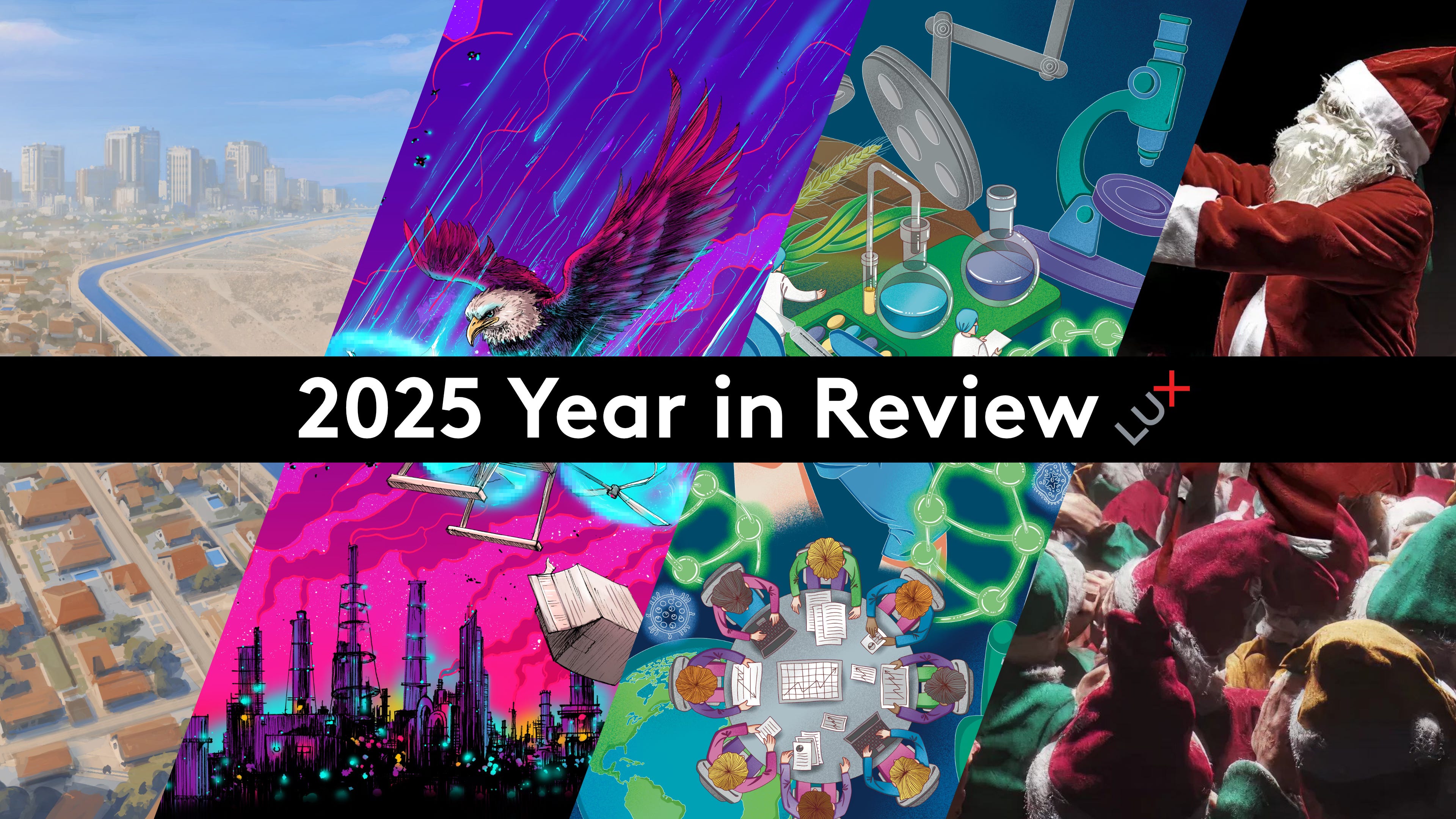
For those counting, we published 104 newsletters, 47 podcasts and four new scenarios. We also hosted about 24 events including runthroughs of Riskgaming scenarios, community meetups and geopolitical dinners. In total, about 500 people got to join us live for an experience — definitely an upgrade thanks to Laurence Pevsner joining as my partner at the tail end of 2024.
As always, thanks for reading, listening and attending — your commitment has allowed Riskgaming to turn into a powerful institution for profound thought on some of the most complex issues facing the world today.
Highlights from 2025
We hosted 60 senior leaders from the United States and the United Kingdom for a biotech summit at the U.K.’s embassy in Washington DC as part of Prime Minister Keir Starmer’s trade mission to the United States.
I pissed off some Pennsylvania politicians with an op-ed in The New York Post on President Trump’s horrifying deal approving U.S. Steel’s acquisition by Nippon Steel.
I pissed off some public sector labor unions and mayors with an aggressive essay in City Journal on the need to use AI to automate more of city government.
Dozens of people in New York City and in Los Angeles played our biotech game Experimental Automata during Upfront Summit.
We were profiled by Business Insider, Payload Space and The Wall Street Journal, complementing past coverage in NBC News and The Information.
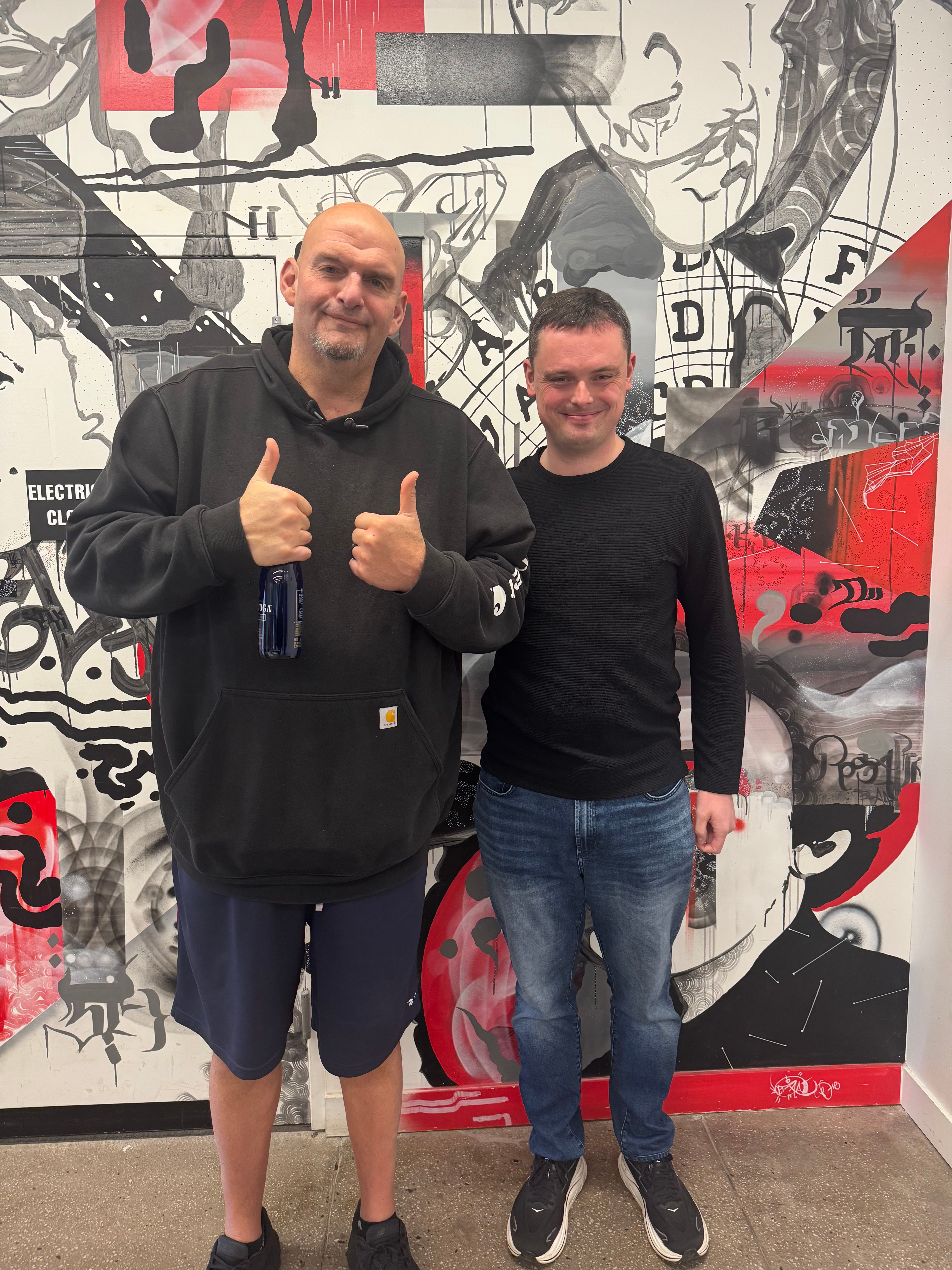
I learned that Senator John Fetterman is a complete giant compared to me:
We hosted a senior delegation of Canadian political and business leaders in Toronto to play No Man’s Land.
Laurence launched Gray Matter with sellout events in New York City and in California, doubling down on biotech gaming with our first live trading card game. Negotiations were fierce, and you know you have a winning game when it is impossible to bring the room back to order so you can give the final results. We’ll publish the game in early 2026.
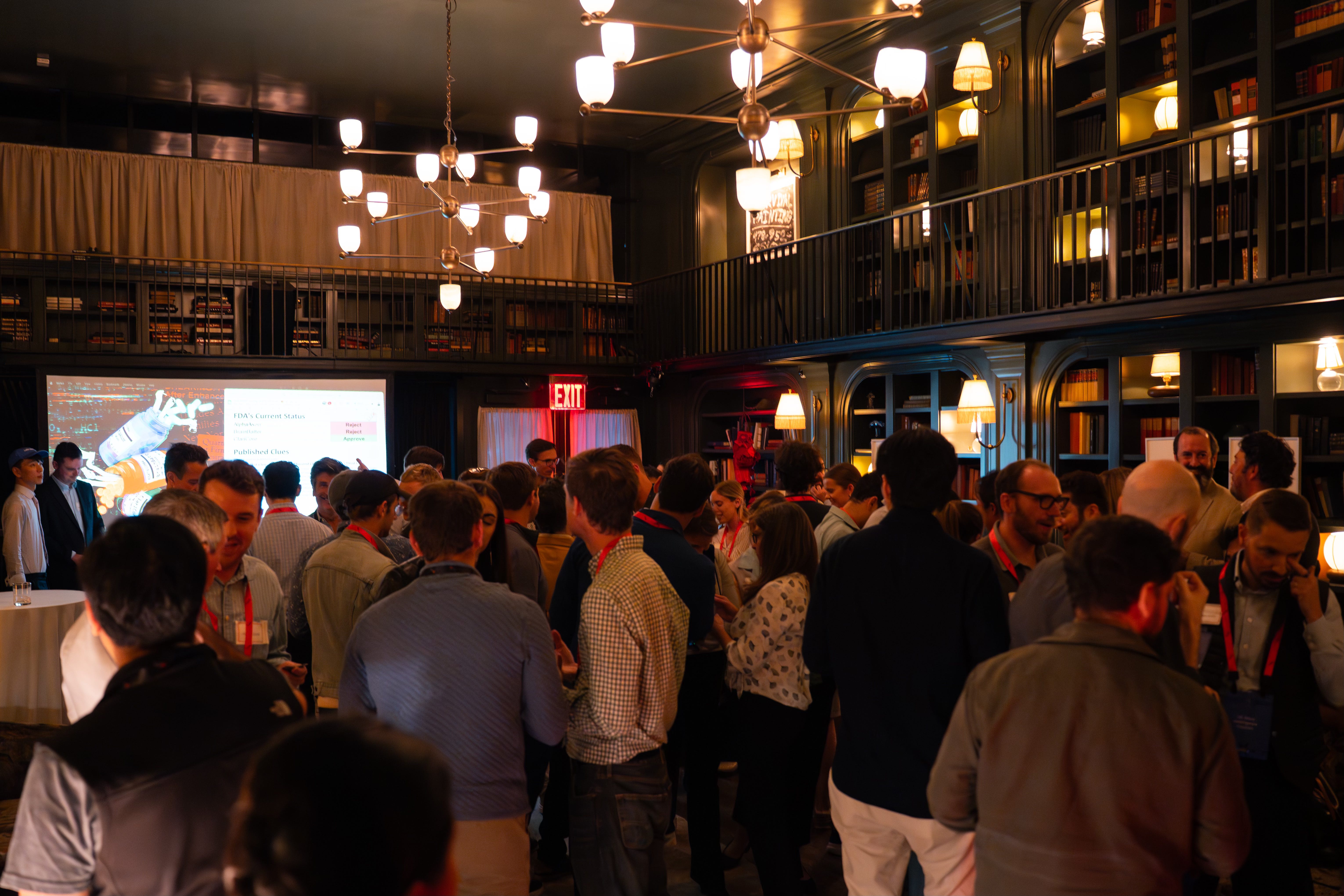
We hosted a prominent former U.K. defense (I’m sorry, defence) minister for a Riskgaming session (who is excellent at negotiation, I have to say).
We had a great time launching Ian Curtiss’s Southwest Silicon to a distinguished group in London from the U.K.’s Foreign and Commonwealth Office, the Department of Business and Trade and other ministries as well as in DC with Eric Schmidt’s Special Competitive Studies Project.
We hosted our first comedy revue with Truth Santa, which will always have a special place burned into my heart (note to self: never write a comedy show under deadline).

New Riskgaming Scenarios for 2025
Experimental Automata: A Global Investigation of the Future of Digital Health and Biotechnology — a salon experience for 60 that educates on the progress coming in human wellness and agriculture.
No Man’s Land: The AI Singularity and the Future of American National Security — the most in-depth full-immersion game we’ve ever made. This game takes eight players through the challenging tradeoffs of balancing commercial and defense security in the AI industry alongside a zany storyline that has now come to fruition in the real world.
Southwest Silicon: Water, Semiconductors and the Future of American Economic Security — a full-immersion game that simulates the strict tradeoffs facing water-parched homeowners, farmers and the emerging chip fab industry in Arizona’s Phoenix Valley.
Truth Santa: A Lux Riskgaming Holiday Experience — our holiday comedy revue that we hosted in SF and NYC. You had to be there, but you can see some notes and photos on the game’s unlisted page.
Best Newsletters of 2025
We switched to Substack this year, which was a huge help in terms of user experience and that all-important growth metric. Here were my favorite pieces of writing this year:
Make gray-zone war expensive again — Unusually for me, defense was not one of my main topics this year, but gray-zone warfare is a perennial interest of mine. The costs of hybrid war have declined dramatically, encouraging more state and non-state actors to use these tactics to tremendous effect. We need to raise the costs again.
The machine burns down — A meditation on a massive data center fire in South Korea and E.M. Forster’s The Machine Stops. Our lives are increasingly handled by machines that are now central points of failure for our society. Catastrophe awaits without better resilience and chaos engineering.
Open secrets harm society far more than AI or disinformation — It’s the age-old story of the emperor’s new clothes: Everyone knows and agrees on facts that can’t be said out loud. It’s a pattern of behavior profoundly corrosive to democracy.
Should AI recommend God? — AI chatbots like ChatGPT respond from an agnostic/atheistic point of view that reflects Silicon Valley’s mainstream values. To what degree should popular religions be brought up as paths in these chats? Is proselytizing through technology immoral?
Why is economic data disappearing? — The declining quality and transparency of American and Chinese economic data mean that the twin superpowers are increasingly weaponizing perceptions of their economies at the expense of reality.
The taps are dry and the rivers are flooded — A meditation on rivers inspired by James C. Scott’s In Praise of Floods. We need to pay more attention to water security.
We’re finally predicting the weather accurately — Small progress made annually can add up to massive change over time. Weather forecasting improves by about a day every decade, and that is radically enhancing industries from logistics and agriculture to air travel.
Uncle Sam is a terrible board member — My screed against the U.S. government taking board seats at U.S. Steel. The government can’t be a robust board member when it doesn’t have economic alignment and fails in its fiduciary duties.
Tech is turning the Middle East into a pivotal region — Our image of the Middle East needs a dramatic renovation. It’s now a bountiful land of opportunity, dynamism and surprise — and it’s becoming a powerful economic fulcrum in innovation.
Riskgaming against a world on fire: A manifesto, of sorts — This is the longest post of the year and a summary of my goals with Riskgaming as we moved to Substack. We constantly strive to avoid easy solutions to complex problems while uncovering the deep interconnections that constrain and direct today’s events.
Is Plagiarism Dead? — AI is radically changing the definition of creativity and ownership. What is the future prognosis of the norm against plagiarism as AI tools reshape what we think of as originality?
Asteroids, xeno-kidneys, planes and H5N1 — A deep dive into different types of risks and why it is still so hard to mitigate long tail risks even when they are predictable.
Should you wait to have kids? — New biological technologies under development will radically improve the health of children right from conception. In the interim, that dramatically raises the relative risk of having children the next few years.
The Best Podcasts of 2025
For your listening pleasure over the holidays, we’ve posted a special podcast episode recapping the year titled “11 Clips That Defined 2025.”
The inside story of the billionaires fighting for space — The Washington Post’s Christian Davenport on Elon Musk / SpaceX, Jeff Bezos / Blue Origin and the race to colonize the atmosphere, the moon and ultimately Mars.
Why AI safety is like a bolt in a croissant — Former Popular Science editor Jacob Ward on the ethical dilemmas facing the big general-purpose LLMs from OpenAI and Anthropic.
America’s degrowth lawyers need to learn from China — Dan Wang talks about his everyone-is-reading-it book Breakneck and what we can learn from China’s engineering state and America’s lawyer society.
The CIA in the 21st Century — The epic espionage chronicler Tim Weiner talks about his new book about the CIA over the past two decades, from the challenges of the Global War on Terror to its renewed war against superpower adversaries Russia and China.
Intel, chips and America’s future — Dylan Patel of Semianalysis and I debate Trump’s partial bailout of Intel and what it means for the future of industrial policy and chips.
What’s next for European defense autonomy — With Russia continuing to wage a brutal war on Ukraine, I talk with venture capitalist Eric Slesinger on the prognosis for defense innovation on the Old Continent.
How Jane Jacobs got Americans stuck — The Atlantic editor Yoni Appelbaum discusses his new book Stuck on how declining geographic mobility is limiting opportunity for millions of Americans — and how to get people moving again.
Can we ever defend against agricultural warfare? — Alicia Ellis, Arizona farmer and global security professor at ASU, talks about a new domain for conflict: agricultural security and the food supply chains that keep people nourished.
Europe needs national champions, now — An in-depth discussion of Europe’s present place in the world from BCA Research’s chief strategist Marko Papic.
How can we make the internet fun again? — Renée DiResta is one of the original researchers of the internet, and she’s made it her mission to find the joy again in this once optimistic medium.
How Russia is bringing the cost of global sabotage to zero — My favorite episode of 2025 was with Daniela Richterova of King’s College London. We discuss how Russia has reduced the cost of sabotage roughly to zero by taking advantage of the gig economy, cryptocurrency and increasing polarization in the West to find solitary allies on the cheap.
That’s the end of 2025 — as I joked on the podcast, I am sure 2026 will be so quiet that we will have to shut down for a lack of content. Okay I’m kidding, but let’s just hope there isn’t a nuclear war before we all return.