Straddle powers revisited, the no-hire economy, influencers boxing, and more. Plus Lily Boland on foresight, gaming and changing people’s minds.

From around the web
1. Same game
Earlier this month, I wrote about how to succeed as a straddle power: Rather than increasing strategic maneuverability, blunt decisions often transform a complex game of negotiations into a linear tug-of-war. It turns out, I may have been channeling a 1500s report from Daniello de’ Ludovisi, a Venetian diplomatic envoy, assessing how Venice might maintain careful strategic neutrality between Emperor and Sultan.
Now let your most excellent lordships consider how much that military is thereby becoming disordered and unnerved, and that state weakened; and although I am certain that this is known to Ibrahim (who is of good intellect, but not of such virtue as to be able to remedy so many inconveniences), yet the love he has for himself, much greater than that which he has for his lord, makes him prefer to be alone in a dominion that is not very strong, compared to what it could become through diligence, than to be one of many companions in a firmer and stronger one. From this, however, comes great benefit to your Serenity; for in order to remedy so many disorders, he applies all his efforts to maintain good relations with you, as I have been well able to judge, knowing that losing your friendship would perhaps, on some occasion, be to the detriment and ruin of that state.
2. Deep freeze
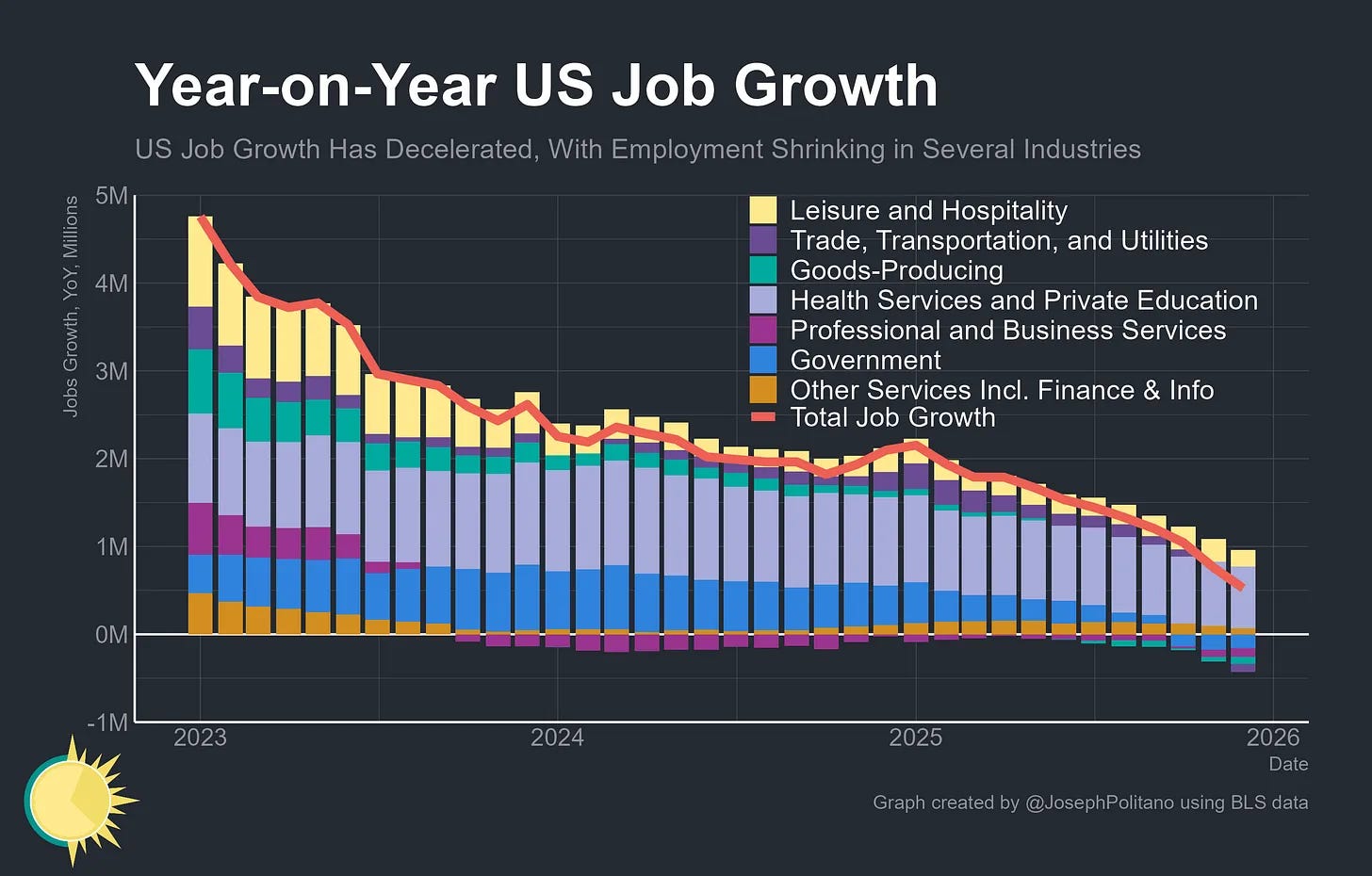
As in the 16th century, part of the reason the playing field is opening up for straddle powers is the shifting strengths and dynamics among the players at the top. As the United States faces down China (and Venezuela and Greenland?), it is also contending with headwinds at home. Laurence was impressed by Joseph Politano’s look at employment trends over the last year. The bottom line is that the U.S. job market has stalled dramatically, hitting young workers and low-income earners the hardest.
3. Hard pass
Maybe the weird job market is why so many influencers are trying to become boxers. In a piece in New Lines Magazine, Tam Hussein bemoans how Jake Paul, Andrew Tate and the like have turned boxing matches from displays of genuine mastery to spectacle entertainment. Their ability to headline fights against deeply talented world champions is an object lesson in the way we’ve come to value fame over hard work.
Once again, the rules bend for him. That, then, is my problem with Paul. By sharing the stage with Joshua, his presence teaches this generation that mastery doesn’t matter — that hard work, patience and time count for nothing.
I saw this exact thing over the holidays, when I attended a poetry reading by a friend. The first person read a “poem” about the escapades of her two dogs; she admitted she had written it using ChatGPT. It was witty and fun, I suppose. But what was she expecting — applause?
4. Just works
Another paean to hard work: Scientist-in-residence Sam Arbesman recommends Anil Dash’s “How Markdown Took Over the World.” You might think you don’t use the plain-text formatting system, but you probably do. Its the backbone of developer tools, messaging apps and AI systems alike, and it quietly succeeded because it was designed to solve a real problem, was released for free and arrived at the perfect moment.
It’s important for everyone to know that the Internet, and the tech industry, don’t run without the generosity and genius of regular people. It is not just billion-dollar checks and Silicon Valley boardrooms that enable creativity over years, decades, or generations — it’s often a guy with a day job who just gives a damn about doing something right, sweating the details and assuming that if he cares enough about what he makes then others will too. The majority of the technical infrastructure of the Internet was created in this way. For free, often by people in academia, or as part of their regular work, with no promise of some big payday or getting a ton of credit.
5. Pattern break
Finally, if you need to reset your brain, try Tiled.art, a website Sam likes dedicated to tessellations. You can make your own or check out the gallery.