


Grand strategy is a lie, the end of mosquitos, and why the left is ceding AI to the right.

Yes, I know there hasn’t been a Riskgaming dispatch this week — one of our first misses in months. Heavy travel + big plans = bad writing schedule. More to come!
From Lux Capital
Terra Industries raised $22 million in a capital round led by Lux. The Nigerian startup is building autonomous security systems including drones, sentry towers and unmanned ground vehicles.
Financial Times reporting on AI finds that Wall Street investors have started to worry about automation’s impact on white-collar jobs outside the tech sector leading to sell-offs in the financial services industry, trucking and beyond. “It feels like a mob with bats looking for the next hit,” our own Peter Hébert is quoted as saying. “It’s indiscriminate.”
Finally, Tae Kim wrote about memory chip stocks in Key Context, featuring Josh Wolfe.
Smart investors like Lux Capital’s Josh Wolfe and Atreides Management’s Gavin Baker have been adamantly bullish - and right - on memory stocks for a while. They called out how memory makers aren’t just producing commodity chips anymore, the dynamic random-access memory (DRAM) for computers and consumer electronics. They have also become key suppliers of high-bandwidth memory (HBM) for AI servers, which are far more advanced and complex, dare I say, proprietary.
From around the web
1. Not so grand
One of my favorite articles of the last few months. For all my IR people out there: Think you know grand strategy? Check out the latest on the History Does You Substack. As it turns out, “grand strategy” is largely a myth — an intellectually prestigious but vague concept that attempts to bring retrospective coherence to what is, in practice, the very fragmented and improvised process of policymaking.
The further one moves from seminar rooms and closer to institutions, budgets, bureaucracies, and political incentives, the harder it becomes to sustain the belief that coherence is the natural state of affairs. What had once appeared as strategic design began to look like post hoc storytelling; what had seemed like foresight revealed itself as survival filtered through hindsight. Grand strategy does not fail because it was poorly taught or insufficiently refined, but because it asked the wrong questions in the first place.
2. Flight control
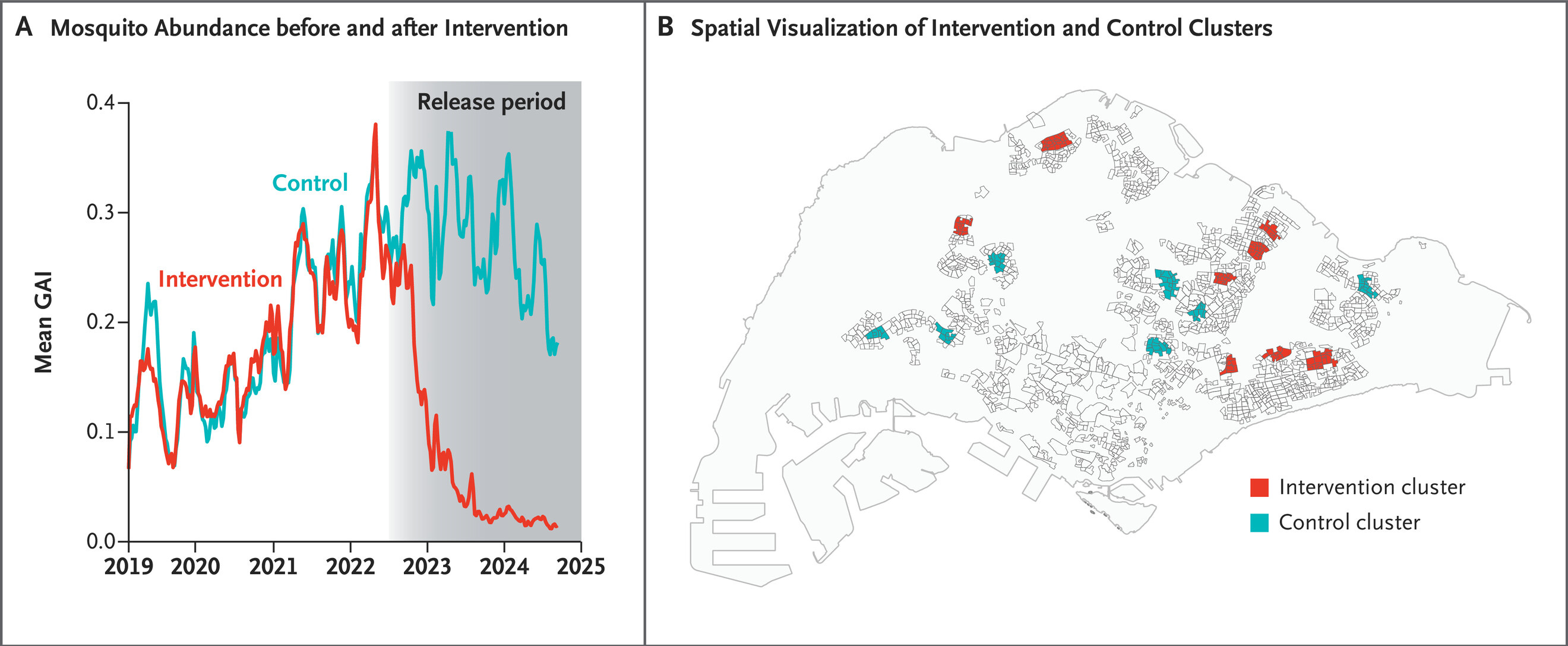
Some things are more strategically coherent than politics, apparently including efforts to eradicate mosquitos. Lux’s David Yang flagged a new study in the New England Journal of Medicine about a trial in Singapore, in which researchers demonstrated that infecting male mosquitoes with Wolbachia bacteria could reduce mosquito populations. Dengue infection rates also dramatically fell.
3. Left to chance
This week, Laurence Pevsner liked a new piece by Dan Kagan-Kans, who argues that the left has tried so hard to dismiss AI as a scam (‘fancy autocomplete’) that it has ceded AI regulation to the right. This dismissal, Dan says, stems from a mix of academic philosophy, tech industry skepticism, and ideological echo chambers.
Still, despite the relative alertness from political quarters, it’s hard to avoid the impression that the right is more alert, both to AI’s opportunity and its danger. That doesn’t mean they are masters of wise AI policy. Both the accelerationists and the industrialists influential in the current administration show it is alarmingly often the opposite. It simply means that, between them and the Steve Bannon anti-tech wing, more or less the entirety of the movement agrees AI is not a fake technology.
4. Self-starter
Finally, Tess van Stekelenburg directs our attention to new work on the origins of life. Researchers have discovered a remarkably short RNA enzyme capable of copying both itself and its complementary strand. This finding suggests the start of life may not have required large, complex molecules and lowers the bar for how self-replication could have spontaneously emerged on early Earth.
‘It substantially lowers the bar that needs to be achieved non-enzymatically before ribozyme-catalysed replication kicks in,’ says Gianni. ‘If this is the path needed for life to emerge, this in turn affects the overall probability of life spontaneously emerging from pure chemistry, which we can estimate to be higher than before.’
From Riskgaming
Ready for war, gray zones, AI in science

Russia’s war footing, the gig economy for terrorism, AI in scientific research, and AI over SMS. Plus Hank Anderson on how AI data centers can help small towns secure their water supplies.Thanks for reading Riskgaming by Lux Capital! This post is public so feel free to share it.