


The Riskgaming newsletter started nearly a decade ago as the brain child of our scientist-in-residence Sam Arbesman, who dubbed it “Lux Recommends.” As we near issue #500, we’re taking a brief moment to revisit his top selections. This week: Sam’s picks on biology ad complexity — from the origins of life to extinction.

Biology around the web
1. Inner space
In 2022, Sam recommended James Somers’s article in The New Yorker on “A Journey to the Center of Our Cells,” which explored how researchers are combining genomics, cryo-electron microscopy, and computer simulations to map the crowded, fast-moving interior of cells. Since the 2022 article, the work mentioned in the article has expanded to a new strain of bacteria, with applications ranging from anticancer therapeutics to host-microbe interaction studies.
Olson told me about an experience he’d had while building a virtual scene inside a red blood cell. The environment was so crowded that he had to make himself small. “I had this feeling that I was in a small plot of land in a huge valley that rose all around me,” he said. “It gave me a totally different sense of the scale.” He had been planting individual membrane proteins in the cell. “I mean, you can read in the literature that there are five hundred thousand of these in the red blood cell. But to actually experience it, in the sense of being in the landscape . . .” He trailed off. I thought of the ribosome extending all around us. It seemed like an environment you could get to know, like a park near your house.
2. Evolution, bottled
Sam also liked an article from Nature on the Long-Term Evolution Experiment (still ongoing), which started in 1988 and tracks 12 E. coli populations, with frozen samples taken every 500 generations to create a revivable “fossil record” for studying evolution in real time. Over 30+ years, it has demonstrated continuous adaptation by natural selection with no apparent upper limit.
Some years ago, we collected and analyzed data on the fitness trajectories that described the adaptation of the LTEE populations through 50,000 generations. We had previously imagined that the bacteria would reach an asymptote—an upper limit—on their fitness in the simple, static environment of the LTEE. But we discovered instead that the trajectories so far are best described by a simple and elegant equation, called a power law, that has no upper bound. Although this equation predicts that the bacteria will change more slowly as time marches on, it implies that adaptation may continue indefinitely.
3. Unconscious
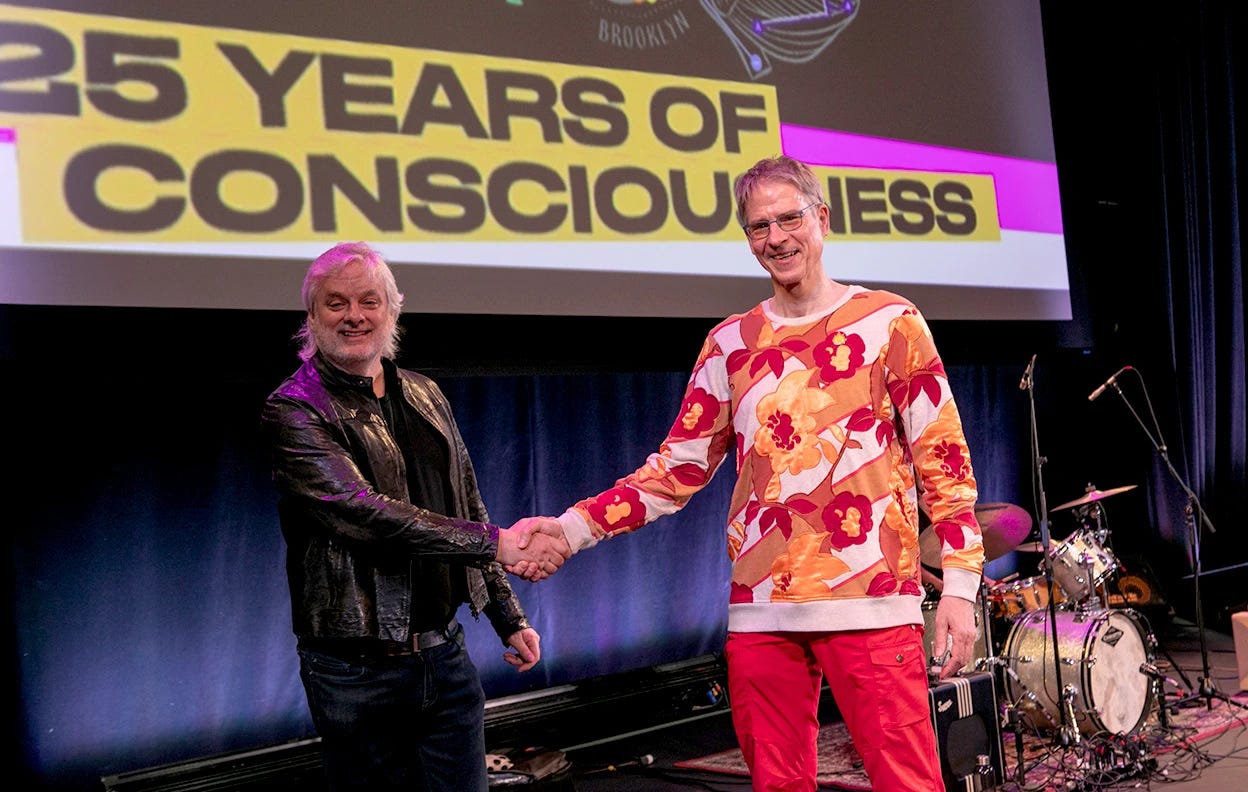
Also in Nature, it is worth revisiting this 2023 article reporting on the conclusion of a 25-year philosophical wager (but not Pascal’s) between David Chalmers and Christof Koch on whether we will understand the neural basis of consciousness. We didn’t in 2023, and still don’t now. So the bet was settled in favor of Chalmers.
4. The meaning of life
Moving to life off this planet. The search for extraterrestrial life has been hampered by a fundamental problem: we don't actually know what life is, having only one example (Earth) to generalize from. On that score, Jaime Green’s piece in The Atlantic was — and still is — an excellent primer on the work researchers have been doing to develop a universal theory of life.
The search for extraterrestrial life is not the kind that is likely to yield an aha moment—not in the sense that, with the tools currently available, scientists are going to look at data brought in from the cosmos and instantly declare, “Yes, this is life.” There are too many technical hurdles, too many variables that will need time to be sorted out. And even accounting for those issues, another obstacle exists—an enduring puzzle that tests the limits of science. The fact is, we still don’t know what life is.
5. Smart as a dodo
Finally, Sam takes us from the meaning of “life” to life’s end. Research published in The Zoological Journal of the Linnaean Society challenged the dodo’s reputation as a clumsy, doomed creature, revealing instead that it was a fast, agile member of the pigeon family that thrived on Mauritius for 12 million years before humans arrived.
The word “dodo” has multiple possible origins. It may have been coined by the Portuguese mariners who visited Mauritius in 1507 and called the bird “doudo,” meaning “fool” or “crazy.” Or perhaps the name came from Dutch sailors, who colonized the island in 1598 and called the bird “dodaersen” (“fat behind”) on account of its generously proportioned rump. A third possibility: Dodo was an onomatopoeia of the bird’s call, which may have resembled the two-note coo that male band-tailed pigeons make to attract mates.
Dr. Hume said that the dumb-as-a-dodo trope might have arisen from the way the trusting bird remained still when approached by half-starved sailors, only to be clubbed on the head and trussed up for dinner. According to journal entries of Dutch seafarers, as many as 50 dodos were killed in a single day.


