Learning how to (really) read, wasting time with the pros, and life at scale. Plus my interview with Christian Davenport on the billionaires’ space race.

Truth Santa
This week, a dictatorial Santa redirected the elves of Santa’s Workshop from global gift giving to building up the North Pole into an AI superpower.
You really had to be there. You had to be there for the comedian joking about how “the North Pole has embraced late-stage capitalism and it is gorgeous. They’re going to start calling me Santa Close, because I am always closing.”

You had to be there for the Lina-Khan-o-meter that determined the North Pole’s antitrust policy (reasonably generous!)

You had to be there for the launch of $antaCoin, for Ballmer Lucky’s haircut and for the dozens of Truth Santa posts put up by our eggnog-drinking Santa.
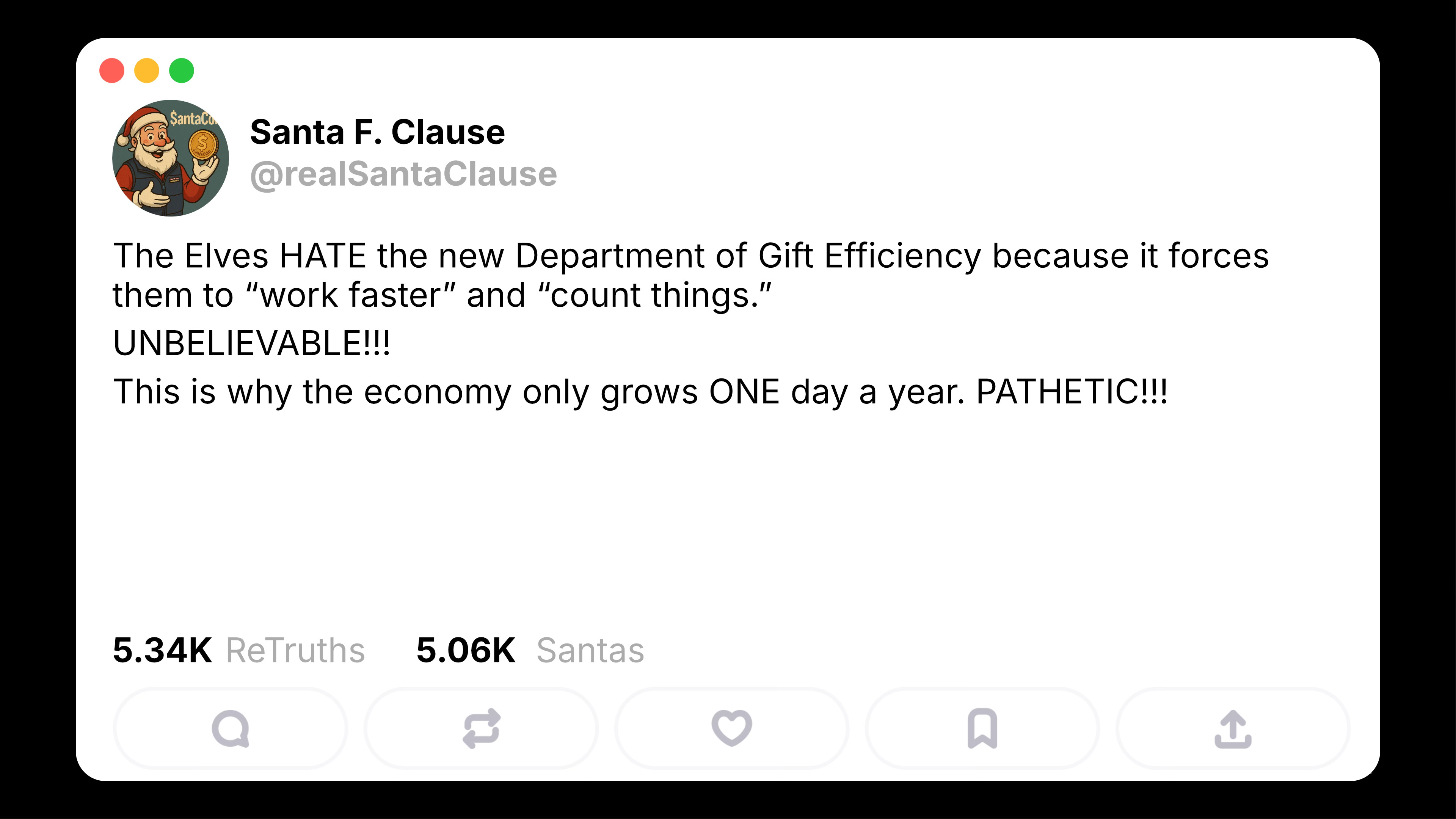
And you had to be there as players searched the room for PornHub datasets in their naughty quest for AI supremacy.

This was the most ridiculous Riskgaming experience we have ever done. And it’s never happening again. So for those who couldn’t be there, we have posted a bit of the story and materials on an unlisted website that will live in perpetuity. In the meantime, have a great holiday!
From around the web
1. Fine print
I hope you get some time to relax with a book over the holidays. If you do, try close reading — the practice of noticing small textual details and building arguments from them. I’ve been inspired by this article from Johanna Winant, a former West Virginia University professor, who describes how teaching her students to read this way helped them realize they could trust their own observations and make meaningful claims about their world.
Let’s start by looking at the text in front of us and pointing to something very small: a single word, or punctuation mark, or even something that’s not there, a gap. Tell me, I would ask as we sat down and opened our books, what is one detail that you noticed? What snagged you? Where were you surprised? At the beginning of every semester, my students would be confused by these questions. They were smart, hardworking young people, and they very much wanted to get the answer right. They pointed to themes, identified genres and symbols, and gestured toward historical contexts.
Okay, I would respond, but now point to a detail, one that’s really on the page and small enough to fit under your finger. I sat, and smiled a little, and waited with the conviction that I wouldn’t be disappointed. And then, reliably, every time, a transformation that seemed like magic.
2. Lower ed
If close reading is a skill universities should be teaching , most of them have lost their way. This week, Laurence flags a piece in the FT by a colleague of his at the Moynihan Center. Carlo Invernizzi Accetti argues elite U.S. universities made themselves vulnerable to the Trump administration’s political attacks by prioritizing research prestige over their civic mission of forming engaged citizens.
The political weather will change. Courts will (one hopes) curb excesses. New administrations will rewrite rules. But legitimacy does not come only from a friendlier federal government. It also comes from the daily experience of students who emerge as capable citizens, and from communities that can see the value those students create.
3. Elite loitering
Enough learning. Let’s move on to holiday travel and the airport lounge wars. If you haven’t read Zach Helfand in The New Yorker yet, you should. Zach took a week-long tour of airport lounges across New York so you don’t have to. From bare-bones Priority Pass offerings with mushy cheesecake to ultra-luxurious spaces with Danny Meyer restaurants, spa facials, and Porsche rides to the plane, choose your travel route this year carefully.
We used to spend a lot more time waiting than we do now. We waited for the mail, for the milkman, for the news, for a ship, for a sign, for the bread to rise, for the tide to ebb, for the cavalry, for good things to come. As people were always waiting for something, dedicating special areas in which to do so would’ve been ludicrous. In the sixteenth century, kings, Popes, Medicis, and other aristocrats began constructing rooms where courtiers would wait. In “The Antechamber: Toward a History of Waiting,” the historian Helmut Puff recounts that, when Mozart was twenty-one and seeking a patron, he complained in letters home about waiting in antechambers across Europe: an hour in Bavaria, another “whole hour” in France, a half hour in a frigid room of a duke and a duchess. When the duchess finally appeared, he told her, “I’d be only too happy to play something but that it was now impossible, as my fingers were numb with cold.” Waiting can make one feel needy, like a baby. The waiter waits because the waitee is too important to.
By contrast, waiters wait in the airport lounge because they are important.
4. Flight risk
Can’t travel yourself? Maybe send a rocket. Some amateurs are getting their projectiles nearly to space. Laurence liked Michael Harmon’s reporting from one club’s monthly launch. The Metra Rocket Club brings together amateur rocket enthusiasts — from retirees to university engineering students — at a New York farm to send off rockets so high-powered they need FAA authorization.
One by one, the rockets shot into the sky. “Deploy, deploy,” Mr. Marote intoned, speaking directly to his rocket’s parachute.
Necks craned skyward, the families cheered as each rocket’s parachute deployed as designed. The men would earn their certification as long as they could recover their rockets undamaged (which they did).
5. Size matters
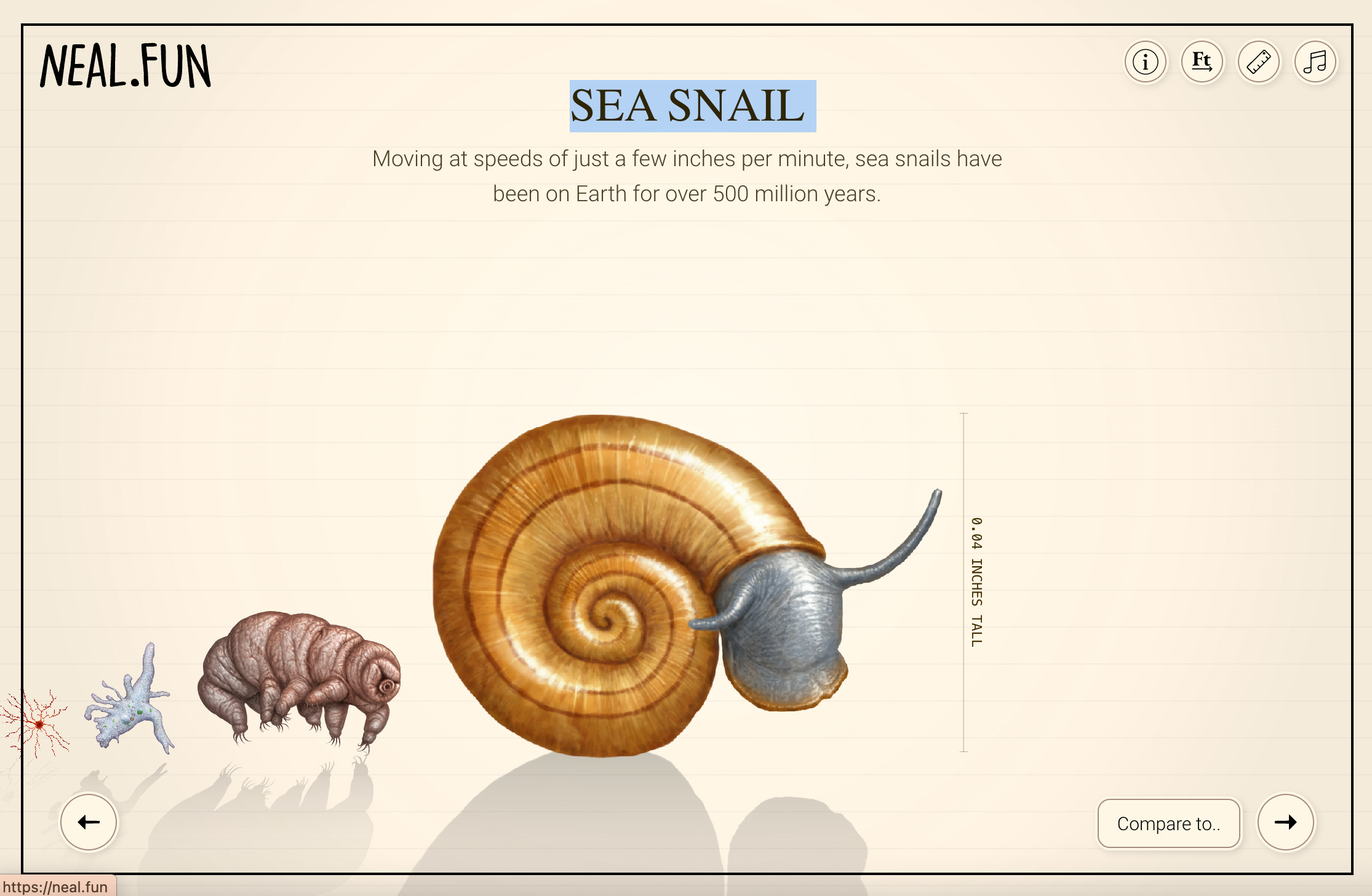
Finally, our scientist-in-residence Sam Arbesman is here to surprise and delight you with a new visualization by Neal Agarwal, of Neal.fun. He maps the size of various life forms — from the humble strand of DNA (2.5 nanometers tall) to the Pando Clone, which looks like a forest, but is actually a single, 108-acre organism in Utah, composed of over 47,000 stems connected by a vast root system.