


Editor’s Note: Today’s post is written by our almost-finished SkillBridge Air Force captain Yuma Kim. Yuma has been expeditious in researching Europe’s space economy and security for our next Riskgaming scenario, and these are some of his lessons learned.
In 2025, SpaceX launched 170 times. Europe, whose Ariane 1 rocket pioneered commercial space launch in 1979, launched just eight times.
This is the negative compound interest on a decision made 12 years ago, when European officials rejected designing their new rocket, the Ariane 6, to be reusable. The next year, SpaceX’s Falcon 9 made its first vertical landing. France’s former economy minister Bruno Le Maire would later admit: “there was a fork in the road, and we didn’t take the right path.”
Since then, Europe has wallowed in the doldrums of a launcher crisis, struggling to retain sovereign access to space. From the final flight of the Ariane 5 in July 2023, the two-year grounding of Vega-C, and the much-delayed lift-off of Ariane 6 in July 2024, Europe finally began its sputtering recovery last year. Although it has restored the bare minimum of access, Europe is only beginning to claw its way toward reusability. As the stunners-wearing French President Emmanuel Macron recognized at Davos: Europe is “sometimes too slow. Foshur.”
Europe now finds itself in a tough space trilemma. It wants strategic autonomy, a world-leading space capability, and to protect the industrial status quo—that is, jobs. It can’t optimize for all three. If you think these sound like classic Riskgaming tradeoffs… you would be right, since that’s what our next game in development, Dead Reckoning, will be about.
In its current approach, Europe loudly proclaims its need for space autonomy while refusing to disrupt the industrial status quo. The inevitable result will be middling capabilities.
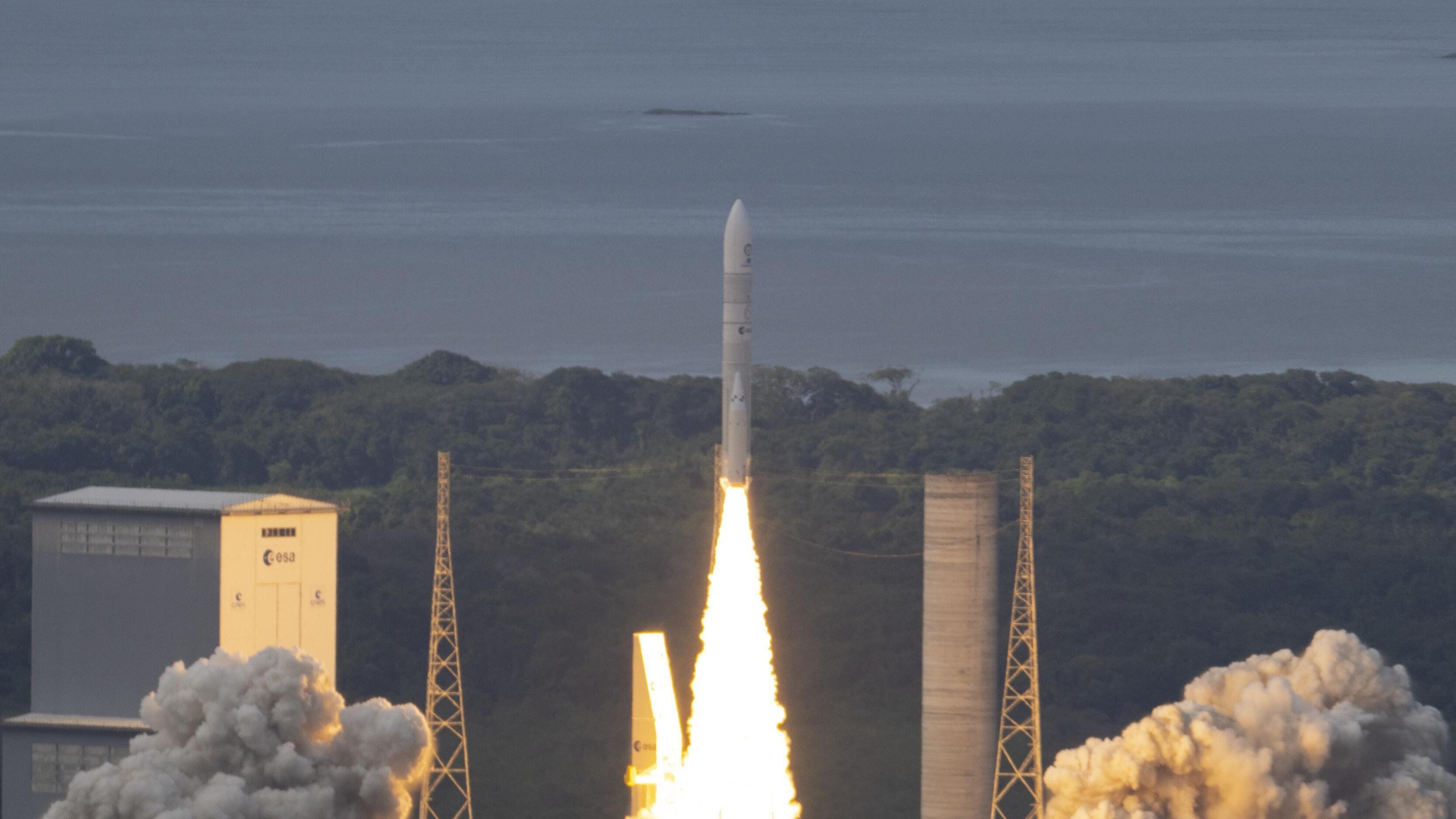
Consider ArianeGroup, the manufacturer of Europe’s only operational heavy-lift launcher, the Ariane 6. The company, itself a 50/50 joint venture between Airbus and Safran, employs 7,600 people across France and Germany and is dependent on up to €340 million in subsidies per year. Ariane 6 is scheduled to launch just 6–8 times in 2026 as it ramps up operations, reaching a tempo of ten launches per year by 2027. ArianeGroup’s subsidiary responsible for launch, Arianespace, will increase its launch rate further only if demand increases. As the company’s chief executive, Alain Charmeau, framed it in 2018, a rocket that can be reused ten times, scheduled for ten launches, would only be built once a year: “I cannot tell my teams: ‘Goodbye, see you next year!’”
Fortunately for Arianespace, 18 launches have been ordered for Jeff Bezos’ Starlink competitor, Amazon Leo (formerly Project Kuiper). Still, relying on a different American company to sustain launch demand is hardly a sovereignty-forward approach for Europe. Moreover, a triangular strategy of playing Amazon off SpaceX will cease to work once Blue Origin‘s reusable rockets come online. As it stands, there is not enough organic demand in Europe to incentivize ArianeGroup to expand their operations, let alone pursue rapid progress toward reusability.
Arianespace’s call for a mandated European launcher preference makes sense from their perspective, but criticism of the company’s track record abounds. As John Holst of Ill-Defined Space observed, “the company appears to be behaving in a manner that is daring the [European Space Agency] to cut off its antics. It’s not behaving as if it’s serious about the launch business. Instead, it’s behaving as an entitled monopoly.”
Europe’s intergovernmental space organization, the ESA, is correct in diversifying from ArianeGroup and Avio, the Italian maker of Vega-C — the under-used medium-lift launcher also reliant on €21 million in subsidies per year. ESA is now pursuing reusability with the European Launcher Challenge, first established in 2023. Critically, the ESA is implementing a significant reform to the ELC, softening the organization’s adherence to the geographical return principle, or geo-return, which requires every euro contributed to the ESA by a member state return a euro to domestic industries.
Such forced fairness has predictably resulted in market distortions and lowered competitiveness. At a 2023 conference, the chief executive of ArianeGroup Germany, Pierre Godart, complained about geo-return: “I cannot choose my supplier… Even if I have suppliers who are not performing, I cannot change them.” Geo-return’s critics are legion: the Draghi report on European economic competitiveness advocated scrapping the policy and the head of France’s space agency called it “poison.”
In sum, Europe doesn’t have reusable launch capability because it doesn’t have enough satellites worth launching. Europe can’t afford to launch a proliferated LEO constellation because it doesn’t have affordable launchers.
With its launch challenge, the ESA is finally listening to the critics. Rather than rely on geo-return, the ESA is experimenting with a concept called “fair contribution,” with five competition finalists selected first for their technological and business maturity, with member states then funding their desired champions. The program allocates €900 million across five reusable launcher startups, with the ESA acting as an anchor customer for future missions to stoke continued private investment.
The idea is to mirror NASA’s success with the Commercial Orbital Transportation Services (COTS) program, which provided SpaceX $396 million in milestone-based funding to seed the development of Falcon 9 in the early 2010s. Since then, SpaceX has raised a publicly reported $11.9 billion of venture capital, and is now preparing for a blockbuster IPO that could value the company well above $1 trillion.
Competition is useful to speed innovation, but that competition assumes a prize on the other side of the race. Europe is offering no prize today, neither for ArianeGroup or Avio as incumbents, nor for the five new ELC entrants. By comparison, after SpaceX proved its worth with NASA, the agency contracted $1.6 billion for 12 operational cargo missions to the International Space Station. Europe lacks such a unified prize. Without one, Europe will spend more to launch less, ultimately developing middling capabilities that pale to SpaceX.
While public revenues were valuable, SpaceX’s true genius was harnessing reusability to unlock an extraordinarily lucrative prize of its own: a virtuous cycle with their proliferated Low Earth Orbit constellation, Starlink. Starlink operates roughly 9,000 satellites in LEO today, accounting for two-thirds of all satellites in orbit, and contributing up to 80% of SpaceX’s $8 billion in profit last year.
The European Union’s flagship space program, IRIS², is an attempt to create a similar incentive, namely a sovereign, multi-orbital constellation of 290 satellites providing a “Starlink alternative” for Europe by 2027. Unfortunately, the EU’s procurement process for the now €10.6 billion project (up from €6 billion), relying on a single non-competitive consortium of primes given a 12-year contract, all but guarantees that the project will be doomed to mediocrity.
Sven Meyer-Brunswick, a principal at Alpine Space Ventures, made this comment on IRIS² prospects: “I think IRIS² is dead in the water, frankly... It’s not a competitive program. It should have been started completely differently.” IRIS² won’t reach full operational status until 2030 at the earliest, for nearly twice the original cost, and with serious uncertainty around its private financing. This risks a repeat of the full-blown governmental rescue of Galileo, the EU’s sovereign GPS-alternative and previous attempt at a public-private partnership in the space sector. At yet another fork in the road, this time around procurement, Europe chose yesterday’s approach.
Europe is indeed focused on sovereignty, as diminished as it may be, and it is getting mediocre capabilities, but the upshot of course is the allocation of jobs through procurement. Europe’s space manufacturing sector employs over 66,000 people, with four large industrial groups (Airbus, Thales, Safran and Leonardo) directly responsible for more than half of total space industry employment in the EU. Unfortunately, job allocation has taken precedence over entrepreneurial merit. When Airbus’ space division announced 2,500 job cuts in October 2024, citing $1 billion in losses over the preceding year, the cuts had to be politically apportioned across Germany, France, Britain and Spain. Moreover, they would not be implemented until mid-2026, taking a full two years to “right-size” the company.
Meanwhile, the primes will justify consolidation under the guise of efficiency, framing their efforts as necessary to become “European champions.” The proposed merger of Airbus, Thales and Leonardo’s space divisions would create a 25,000-person behemoth. With €6.5 billion in annual revenue versus SpaceX’s $16 billion, the primes may be correct in their desire to benefit from scale. But it will prove far too tempting for European leaders to direct their spending to this mega-prime thanks to its convenient industrial spread, with jobs across Belgium, France, Germany, Italy, Poland, Spain and the United Kingdom.
If they do, it will exacerbate Europe’s worst tendencies against competitiveness; as noted by Raycho Raychev, CEO of Bulgaria-based Lux portco EnduroSat: “The European agencies are biased towards a few very big players… tenders typically almost exactly describe the technical solution offered by a certain company instead of describing the challenge and choosing a winner who is best able to solve it.”
To compete properly with SpaceX, Europe may eventually need an excellent, near-monopoly provider to emerge, but only through disruptive competition that is allowed to take market share from incumbents — regardless of where the jobs are. Until that happens, politically-driven mega-primes would simply ensure even less competition and innovation. Europe would be left as vulnerable in satellite manufacturing as it was in the doldrums of the launch crisis, reliant as they were on Arianespace.
In sum, Europe doesn’t have reusable launch capability because it doesn’t have enough satellites worth launching. Europe can’t afford to launch a proliferated LEO constellation because it doesn’t have affordable launchers. Europe’s launchers won’t be affordable until they are reusable and launching at capacity and at cadence. Shot through this Catch-22 are Europe’s issues with geo-return and non-competitive primes — the industrial status quo.
The only path to cutting-edge capability without accepting industry disruption is to partner with leading American companies. If Starship is able to bring launch costs even remotely close to the $10 per kilogram Musk mused about, all manner of orbital economics become tenable. If AI data centers can become cost-effective with Starship, so too can European satellite constellations. With Starship, Europe could launch an expanded and viable IRIS²; continue evolving Galileo’s position, navigation, and timing services; and establish its new remote sensing capability, called the Earth Observation Government Service. By hitching a ride with SpaceX, the European Space Shield could become a reality.
European concerns about Elon Musk are valid, but here’s a counterintuitive strategy: post-IPO, SpaceX will need to be even more responsive to growth-demanding shareholders. European institutional spending represents the vast majority of the available space market in Europe. Instead of framing the dependency of Europe on SpaceX, the frame should really be that SpaceX is dependent on European expansion for revenue and profit growth. SpaceX shareholders will not tolerate cutting off Europe in Muskian shenanigans if it means a slash in market cap. After all, the oft-told story of Musk’s disabling of Starlink access for Ukraine misses a key detail: he had been providing Starlink effectively for free. Once the Pentagon began officially footing the bill, the disruptions ceased.
Europe has two valid options: rely on SpaceX’s launch capacity for cost-effective launch or avoid SpaceX completely by pursuing painful procurement reforms. The middle is what we dub the “dependency trap,” with Europe reliant on SpaceX for critical European launch but not a large enough customer for shareholders to care if access is shut off. When SpaceX launches 170 rockets in a year, half of those should be European funded. If Europe treats Starship not strictly as a threat, but as an opportunity, the continent can show Musk that dependency cuts both ways.
Mandatory Disclaimer: The views expressed are my own and do not constitute endorsement by the Department of Defense, Department of the Air Force, or the U.S. Government. All references, including external hyperlinks, to non-federal entities do not constitute or imply Department of Defense, Department of the Air Force or U.S. Government endorsement of any company or organization.
 | A guest post by
|
Great article! spot on diagnosis of European illness