


How the study of consciousness fell asleep at the wheel, surprising biomedical advances, and why Tylenol beats Advil.

From Lux Capital
Majestic Labs AI, which has raised $100 million from backers including Lux, has built a new server system and chips designed to solve the “memory wall” bottleneck that limits how fast large AI models can run. Each server can scale up to 128 terabytes of memory — roughly 1,000x what competitors offer.
Lux portfolio company Cognition, meanwhile, is partnering with Mercedes-Benz to accelerate software engineering across their global engineering teams. And Medra’s Michelle Lee unveiled America’s largest autonomous lab, Medra Lab 001.
Finally, check out Runway co-founder and CEO Cristobal Valenzuela on the Equity podcast (where many a blue moon ago, I was co-host). He talks about where video generation goes from here and Runway’s ambitions beyond Hollywood.
From around the web
1. Senseless
Let’s start this week with a pick from Laurence. He found Erik Hoel’s anti-recommendation of Michael Pollan’s new book on consciousness surprisingly stirring. Erik argues consciousness research has stagnated because the field has been underfunded, overly academic, and dominated by researchers proposing endless competing pet theories rather than rigorously testing them — and all while the subject has become increasingly urgent given AI’s rise.
If the 2020s were all about intelligence, then necessarily the 2030s will be all about consciousness. Intelligence is about function, while consciousness is about being, and forays and progress into understanding (and shaping) function will in turn force our attention toward a better understanding of being. And if the answer to “Why has consciousness not been solved?” is secretly “Material and historical conditions made it hard for anyone to actually try!” then the answer is to actually try.
I refuse to live in a civilization where we consciousness researchers have so obviously failed. I refuse to live in a civilization where we cannot tell consciousness from non-consciousness. Where we can offer no guidance for the future. Where we cannot explain the difference between actually experiencing things vs just processing them. In the short term, this is destabilizing and harmful. In the long term, it may be literally existentially dangerous.
2. Vital signs
Not stagnant these days: biology. Over at Works in Progress, Saloni Dattani and Niko McCarty chronicle recent biomedical advances including a major surge in deceased-donor organ recoveries thanks to new techniques, a breakthrough pancreatic cancer drug (daraxonrasib) that roughly doubles survival, and a highly effective new hypertension drug (baxdrostat). It also covers disappointments and curiosities — semaglutide failing to slow Alzheimer’s, a whole-cell bacterial simulation, the first full mapping of how plants make nicotine, and a viral story about an entrepreneur using AI to design an mRNA cancer vaccine for his dog. H/t editor Katie Salam.
The most viral health story of late concerns Paul Conyngham, a Sydney tech entrepreneur with no biology background who used AI tools to design a personalized mRNA cancer vaccine for his dog, Rosie. Conyngham paid $3,000 to sequence Rosie’s tumor DNA, used AI tools to study the sequence, and then worked with a nearby university to manufacture and inject a custom mRNA vaccine. ‘The tennis ball-sized tumour on Rosie’s hock has shrunk in half’ as a result, according to reporting in The Australian.
Making a one-off mRNA vaccine is not especially hard, as bioengineer Patrick Heizer explains. Researchers cure mice of cancer routinely. It’s much harder to prove that a therapy is both safe and effective in human trials. The $3,000 figure mentioned above is also only the cost of the sequencing itself. The actual cost for these experiments, including reagents and labor, was likely far higher.
3. Bitter pill
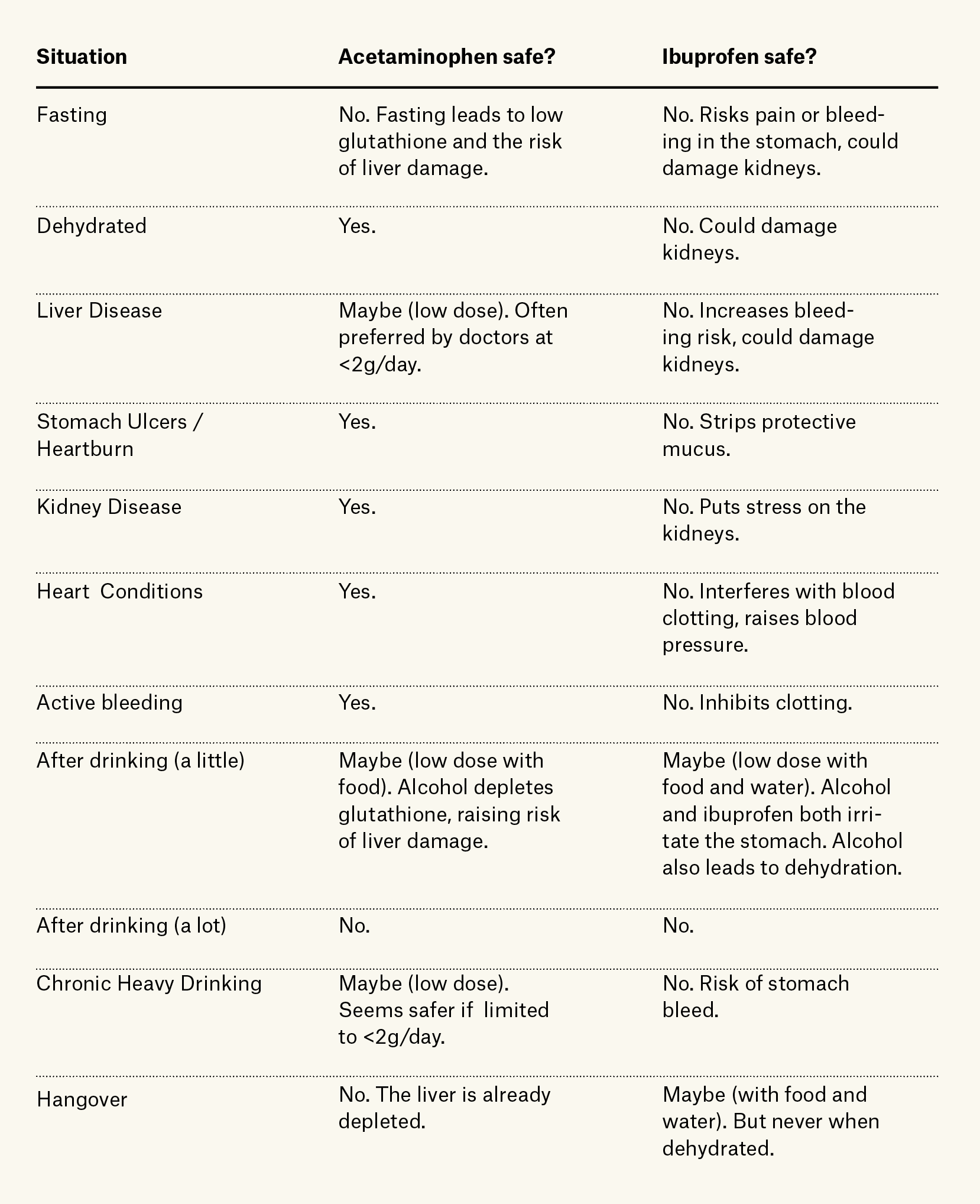
I’ve always been a Tylenol devotee, and now I can pat myself on the back for it. An article in Asterisk Magazine argues that acetaminophen (Tylenol) is generally safer than ibuprofen for most people in most situations. Ibuprofen carries under-reported risks to the stomach, heart, and kidneys. Acetaminophen is largely safe as long as you never exceed the recommended dose (and exceeding it by even a little can be very dangerous). Although doctors broadly agree about this, official sources like the FDA don’t explicitly say so because their job is to evaluate drugs individually, not compare them, which makes understanding relative risks difficult for the average consumer.
4. Engineers versus lawyers
Finally, lots of folks have been talking about the dichotomy between lawyers and engineers, most notably Dan Wang in his book Breakneck. But this short column in the Spectator by Rory Sutherland cliches the view in a very short amount of text:
And yet for all this, institutional stupidity and dysfunction are far more common than individual insanity. Let’s face it, the reason we aren’t building any sodding houses is because our institutions aren’t up to the job. This is in large part because they are designed not to solve problems but to settle arguments; not to create good outcomes, but decisions which are defensible. Consequently, ‘legal’ thinking now precedes ‘engineering’ thinking, rather than the other way around. Law should largely be a corrective discipline; it has become a directive discipline instead.
Hear, hear.
From Riskgaming
SpaceX, sponges, AI God

SpaceX’s IPO is Europe’s nightmare. Can we make our cities more absorbent? And a catechism for robots.
It's becoming clear that with all the brain and consciousness theories out there, the proof will be in the pudding. By this I mean, can any particular theory be used to create a human adult level conscious machine. My bet is on the late Gerald Edelman's Extended Theory of Neuronal Group Selection. The lead group in robotics based on this theory is the Neurorobotics Lab at UC at Irvine. Dr. Edelman distinguished between primary consciousness, which came first in evolution, and that humans share with other conscious animals, and higher order consciousness, which came to only humans with the acquisition of language. A machine with only primary consciousness will probably have to come first.
What I find special about the TNGS is the Darwin series of automata created at the Neurosciences Institute by Dr. Edelman and his colleagues in the 1990's and 2000's. These machines perform in the real world, not in a restricted simulated world, and display convincing physical behavior indicative of higher psychological functions necessary for consciousness, such as perceptual categorization, memory, and learning. They are based on realistic models of the parts of the biological brain that the theory claims subserve these functions. The extended TNGS allows for the emergence of consciousness based only on further evolutionary development of the brain areas responsible for these functions, in a parsimonious way. No other research I've encountered is anywhere near as convincing.
I post because on almost every video and article about the brain and consciousness that I encounter, the attitude seems to be that we still know next to nothing about how the brain and consciousness work; that there's lots of data but no unifying theory. I believe the extended TNGS is that theory. My motivation is to keep that theory in front of the public. And obviously, I consider it the route to a truly conscious machine, primary and higher-order.
My advice to people who want to create a conscious machine is to seriously ground themselves in the extended TNGS and the Darwin automata first, and proceed from there, by applying to Jeff Krichmar's lab at UC Irvine, possibly. Dr. Edelman's roadmap to a conscious machine is at https://arxiv.org/abs/2105.10461, and here is a video of Jeff Krichmar talking about some of the Darwin automata, https://www.youtube.com/watch?v=J7Uh9phc1Ow