


The death of AGI, the real Satoshi Nakamoto, why Twitter sucks, and more. Plus, my anti-recommendation of the week.

From around the web
1. Actually, I am for the Machine
I was excited to read Paul Kingsnorth’s book, Against the Machine: On the Unmaking of Humanity. It’s a caustic polemic inveighing against the profound social costs of the braided networks of technology and capitalism. To his credit, he offers a refreshing look at a tired subject by injecting a healthy dose of spirituality and religion, plus a variegated set of political views that makes him hard to place on any traditional axis. The book is certainly original and deserves its rave reviews.
That said, I came away loving the Machine even more than when I started. Maybe it’s the rose-tinted nostalgia, the overbearing sylvan rootedness, or the prescriptions that always seem to run up against a simple fact: there are going to be 10 billion people on planet Earth in short order, and the rustic rural life is increasingly incompatible with maintaining such a large population. We can decry the bureaucracy of modern medicine, but the alternative is … what? If The Machine Stops per E.M. Forster, we wouldn’t witness a world that is full of charming community life, but one of death à la Cormac McCarthy’s The Road. Behind the horrors of the Machine is the even greater horrors of a nihilism that threatens to leave so many behind.
An original take, but wholly unconvincing. Consider it a rare anti-recommendation.
2. AGI, R.I.P.
On to things we like. Laurence recommends Helen Toner’s obituary for the term “artificial general intelligence.” The phrase, Helen writes, has become too vague to be useful, since today’s AI systems already meet some definitions while falling far short of others—all of which add up to an actively unhelpful muddle. More useful would be talking about concrete milestones, like “fully automated AI R&D” or “AI as adaptable as humans.”
It’s not inherently bad for a concept to be fuzzy - many useful concepts are. Love, life, justice, freedom… As long as invoking the concept lets you gesture in a direction that your listener understands, fuzziness doesn’t have to be a big problem.
For a long time, this was the situation with AGI: we were far enough away from the fuzzy cloud that the specifics didn’t really matter.
3. Map quests
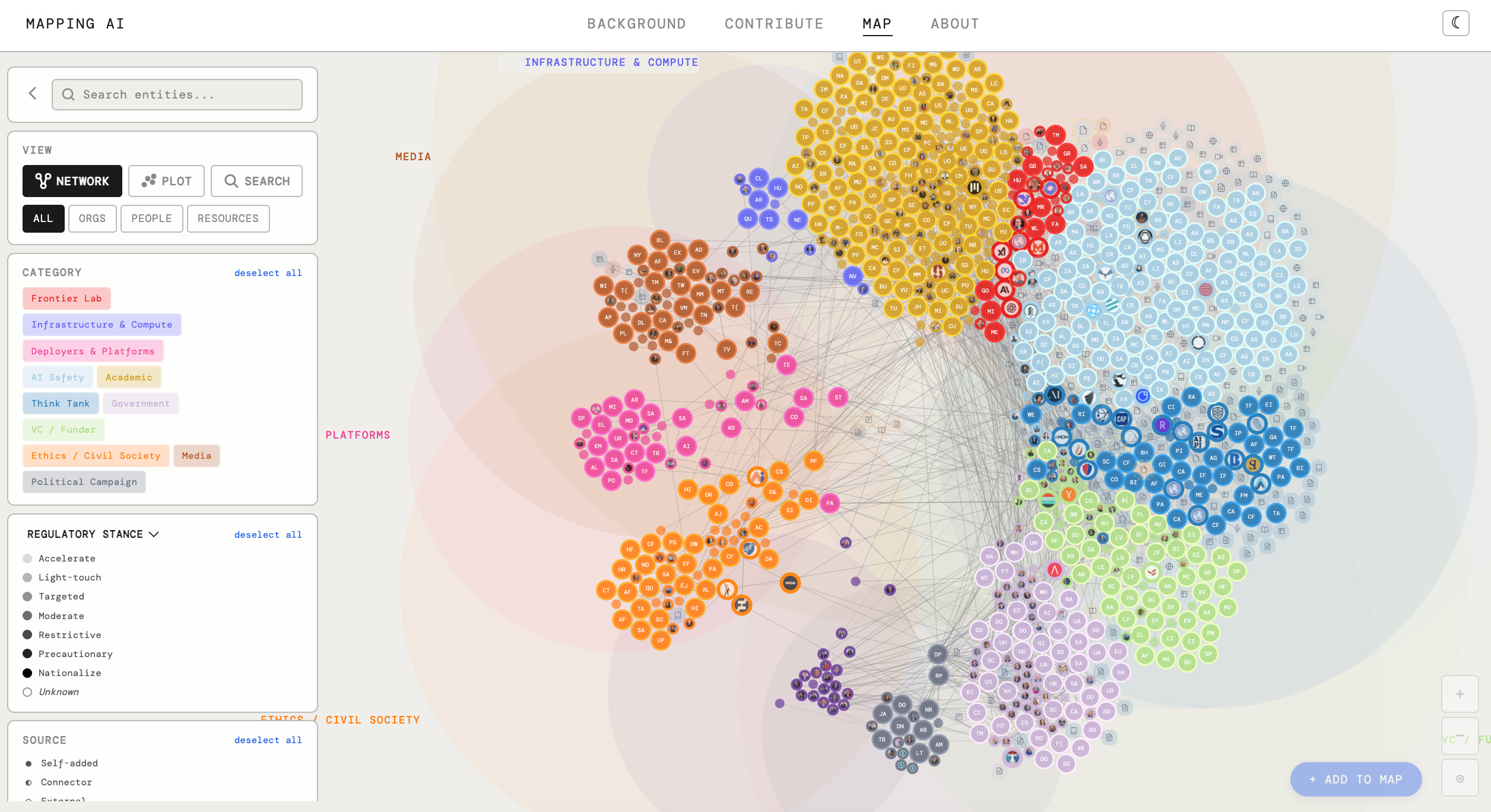
Laurence also dug up two cool new internet tools. The first is a dashboard that tracks YTD traffic deaths due to DC’s delays in rolling out autonomous vehicles. The timeline of regulatory failures is fascinating. The second is a map of the U.S. policy landscape for AI. The map is in pre-launch beta, and some parts are password protected, but its well worth a look. The creators say their goal is “to identify who is shaping AI governance, where the coalitions are forming, and where the gaps are—and to use that map as the foundation for a coordinated policy agenda ahead of 2028.”
4. Gone viral
Laurence and I plus some readers all found Nate Silver’s takedown of social media amusing. Drawing on his experiences at FiveThirtyEight during the Facebook-dominated mid-2010s and the Twitter wars of the late 2010s, he reflects on how social media has become increasingly irrelevant to quality media businesses. And maybe it always was.
Having lived through several eras of social media and web publishing business models, I tend to think of them as ecological systems. There are founder effects, predators and prey, and a lot of different survival strategies, often including mimicry. Most of all, there are selection effects. Some “species” are particularly fit for the peculiarities of the ecosystem and the economic incentives it produces, and within six months to a year, they tend to crowd out all others.
5. Crypto keeper
Finally, if you haven’t read it, check out John Carreyrou’s attempt at uncovering the real identity of the founder (founders?) of Bitcoin. He presents a compelling case that British cryptographer Adam Back is the pseudonymous creator Satoshi Nakamoto, based on striking linguistic similarities, shared ideological beliefs, and the fact that Back outlined nearly every core concept of Bitcoin a decade before it was invented.
My list eventually grew to more than a hundred words and phrases, taking up several pages in my notebook. Among those that caught my eye: “dang”; “backup,” used as a verb in one word; “human friendly”; “on principle”;“burning the money”; “abandonware”; “hand tuned”; and “partial pre-image.”
One phrase — “a menace to the network” — sounded like a line from a science fiction movie. The rest hinted at a weird combination of upper-class Brit, American redneck, computer geek and cryptographer.
From Riskgaming
I’m still out on vacation this week. If you’re looking for more reading material, check out last week’s Lux Recommends!
Iran, data centers, Victorian AI

Who really stopped Iran from getting the bomb? Sanders’ data center gambit. Fun with Victorian AI, and more.Thanks for reading Riskgaming by Lux Capital! This post is public so feel free to share it.
thanks for this. the anti-recommendation concept is genuinely useful